
At APK Guru, we normally cover Android apps, APK safety, and mobile gaming, but the 12TB Steam leak is too significant for gaming history to ignore.
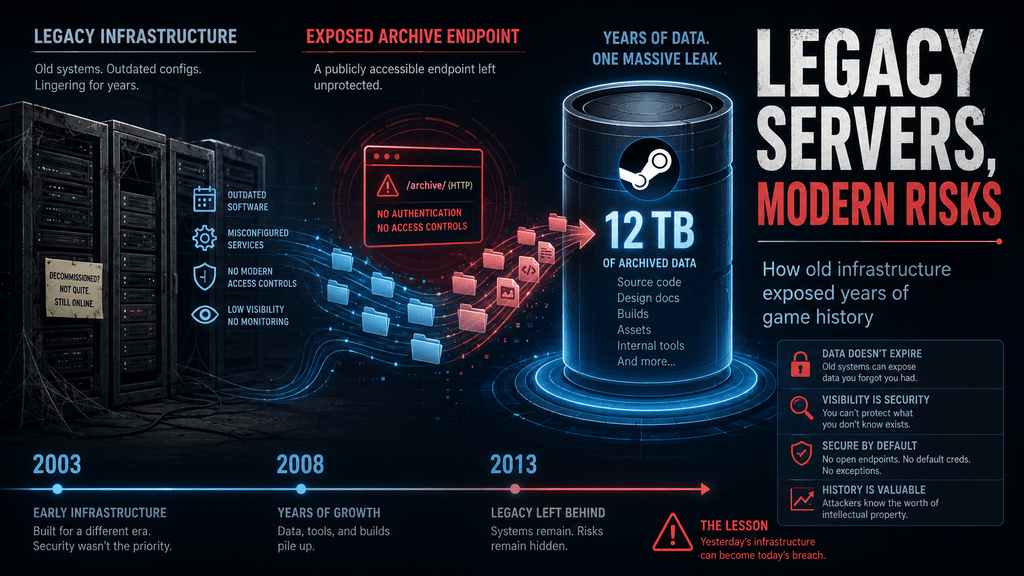
Over the final weekend of August 2026, a huge archive associated with Valve’s old Steam2 content-delivery system began circulating online. Reports describe more than 12 terabytes of material covering roughly a decade of PC gaming history, from Steam’s early years in 2003 through Valve’s move to SteamPipe in 2013.
Inside are reported development builds, prototypes, unused assets, demos, trailers, soundtracks, and content from both Valve and third-party publishers.
That includes early material connected to:
- Portal 2
- Left 4 Dead
- Counter-Strike: Global Offensive
- Valve’s cancelled F-Stop project
- Half-Life 2: Episode 3
- Mafia 2
- Spec Ops: The Line
- Civilization V
- Other games distributed through Steam during the period
But several viral claims about the leak are already getting ahead of the evidence.
There is no confirmed Half-Life 3 build. There is no evidence that someone recently broke into Valve’s modern Steam infrastructure to obtain the archive. And current reporting describes old game content rather than a typical customer-password breach.
Here is what we actually know.

Quick Answer: What Is the 12TB Steam Leak?
The 12TB Steam leak, commonly called the Steam2 Teraleak, is a massive collection of old game files associated with Steam’s legacy content infrastructure.
The files reportedly cover content uploaded between approximately 2003 and 2013 and include retail builds alongside prototypes, betas, unfinished assets, development material, and third-party game content.
Researchers who investigated the archive say it appears to have originated from a publicly accessible legacy endpoint, rather than someone breaking into Valve’s current network using stolen credentials or an exploit. Valve had not publicly confirmed the full archive or issued a detailed response at the time of writing.
The size is what made the story explode, but the historical content inside is what makes it genuinely interesting.
A Simple Timeline of the Steam2 Teraleak
Understanding the timeline makes the leak much easier to follow.
2003: Steam Launches
Valve launched Steam in 2003 as a way to distribute and update PC games digitally.
The older content-delivery architecture, later referred to as Steam2, stored downloadable game content in a system very different from modern Steam.
2003–2013: Thousands of Game Builds Pass Through Steam2
During this period, Valve and many third-party publishers uploaded builds, updates, demos, media, and other content.
That means old Steam infrastructure potentially contained many versions of games that were later replaced or removed.
2013: Valve Moves Toward SteamPipe
Valve transitioned from its older Steam content architecture to SteamPipe around 2013.
That timing is important because the newly surfaced archive appears to stop around the same point. Researchers have cited that cutoff as one reason the Steam2 explanation makes sense.
August 29–30, 2026: Archive Spreads Online
The 12TB Steam leak began attracting widespread attention around August 29–30, 2026, as dataminers and game-preservation communities started examining its contents.
Because the archive is enormous, analysis is still ongoing.

Fact 1: This Does Not Look Like a Traditional Valve Hack
The word “leak” makes many people imagine a hacker breaking through Valve’s security systems.
Current reporting tells a different story.
Valve-focused dataminer Gabe The follower said the archive was obtained through a publicly accessible endpoint associated with the old Steam2 infrastructure. Other researchers have similarly said no password or authentication was required to reach the old content.
That means the 12TB Steam leak appears closer to an exposed legacy archive than a conventional intrusion into Steam’s current systems.
This distinction matters.
A modern breach might imply attackers compromised:
- Steam authentication
- Customer accounts
- Active internal networks
- Current development systems
- Payment infrastructure
The Steam2 story, by contrast, appears centered on old content depots.
However, there is still some uncertainty over exactly when all of the files were collected.
Ars Technica notes that it remains unclear whether every piece was recently pulled from a live endpoint or whether people had privately archived parts of the data years ago and later combined them into the huge collection now circulating.
So the most accurate wording is
Researchers say the data originated from publicly accessible legacy Steam infrastructure; the exact history of how the complete 12TB collection was assembled is still being investigated.
Fact 2: Portal 2 May Be the Biggest Early Discovery
One of the most interesting parts of the 12TB Steam leak is the amount of early Portal 2 material reportedly inside it.
Researchers have found development builds showing ideas that differ substantially from the final 2011 game.
Reported discoveries include:
- Alternate dialogue
- Different story sequences
- Early GLaDOS material
- Prototype mechanics
- Development assets
- Early interface elements
- Concepts later removed from the finished game
Some reports point to a 2009-era Portal 2 build, providing a rare look at how Valve was experimenting before settling on the game’s final direction.
This is particularly valuable to game historians because finished games rarely show how many concepts were discarded during development.
A retail copy tells you what Valve shipped.
A prototype can show what Valve almost shipped.
Fact 3: Valve’s Cancelled F-Stop Project Appears in the Archive
Portal fans may recognize the name F-Stop.
F-Stop was a cancelled Valve project associated with the Portal universe and is often discussed as an early direction for what eventually became Portal 2.
Material related to F-Stop has reportedly appeared in the archive.
This is significant because cancelled games often survive only through:
- Developer interviews
- Screenshots
- Concept art
- Small demonstrations
- References in later projects
Finding genuine development assets gives preservation researchers a better picture of how Valve’s ideas evolved.
It also illustrates why the Steam2 archive is bigger than a simple collection of old retail games.
The interesting material is often what never reached retail at all.
Fact 4: Half-Life 2: Episode 3 Material Is Real — Half-Life 3 Is Not Confirmed
This is the part most likely to generate misleading headlines.
Files associated with a weapon called the Weaponizer have reportedly been identified inside the archive.
That model has previously been connected with Valve material associated with the cancelled Half-Life 2: Episode 3 project.
That is genuinely interesting.
It is not confirmation that Half-Life 3 was found.
Current reporting has not established the presence of:
- A complete Half-Life 2: Episode 3 build
- A playable Half-Life 3 build
- A modern Half-Life project
- Evidence revealing Valve’s current Half-Life development plans
Reports specifically caution that the strongest Half-Life connection discovered so far is historical Episode 3 material rather than proof of Half-Life 3.
So if you see a headline saying
“12TB Steam Leak Reveals Half-Life 3!”
Treat it skeptically.
A more accurate headline would be
Old Half-Life 2: Episode 3 Assets Appear in Steam2 Archive
That may be less dramatic, but it matches the evidence.
Fact 5: The Leak Extends Far Beyond Valve Games
Early attention focused heavily on Portal, Half-Life, Left 4 Dead, and CS:GO because Valve owns Steam.
But this is not just a Valve development archive.
Steam distributed games from hundreds of other developers and publishers during the Steam2 era.
A PC Gamer reports that researchers are finding prototypes and old builds linked to third-party games, including Mafia 2, Grand Theft Auto 3, Spec Ops: The Line, and Civilization V, among others.
Other reporting has mentioned material connected with titles or franchises such as
- Fallout
- Resident Evil
- Call of Duty
- Sonic
- Mirror’s Edge
- Batman: Arkham Asylum
- Dragon Age
That potentially makes the 12TB Steam leak relevant to dozens—or perhaps hundreds—of separate development histories.
And that creates an uncomfortable problem.
Third-party developers may have placed private or unfinished builds onto Valve’s old infrastructure without ever expecting those files to become publicly available years later.
The historical value is enormous.
So are the copyright and ownership questions.
Fact 6: Early Left 4 Dead and CS:GO Builds Are Being Examined
Valve fans are also digging through early versions of Left 4 Dead and Counter-Strike: Global Offensive.
Reports describe prototype CS:GO material with early maps, weapon content, interface elements, and visuals different from the final release.
Left 4 Dead development material is also reportedly present.
These builds can reveal things normally hidden from players:
- Placeholder assets
- Experimental user interfaces
- Removed maps
- Temporary character models
- Different gameplay systems
- Features that failed testing
The final game is usually the result of years of deleting ideas.
Leaks like this reverse that process.
Instead of seeing only what survived development, preservation researchers can examine what developers tried and abandoned.
Fact 7: 12TB Does Not Mean 12TB of Secret Unreleased Games
This is another important correction.
A huge number like 12TB sounds as though Valve accidentally released thousands of complete unreleased games.
That is not what current evidence suggests.
The archive reportedly contains a mixture of:
- Duplicate files
- Retail builds
- Old patches
- Development builds
- Demos
- Trailers
- Soundtracks
- Temporary files
- Prototype assets
- Incomplete projects
Hardware Busters notes that much of such a huge archive is likely to consist of duplicates, broken material, placeholders, and ordinary build history rather than sensational discoveries.
That means researchers may spend months separating meaningful historical material from routine development debris.
The 12TB Steam leak is important because of its scale and depth—not because every gigabyte contains a secret game.
Does the Steam Leak Affect Your Steam Account?
Based on what has been publicly described so far, this event is being reported primarily as an archive of game content and development material, not as a dump of Steam customer credentials.
Major reporting has focused on:
- Game builds
- Steam depots
- Prototypes
- Assets
- Development files
- Media
rather than usernames, passwords, or payment details.
So the 12TB Steam leak should not automatically be confused with a normal customer-data breach.
That said, good Steam security habits remain worthwhile regardless of this incident:
- Use Steam Guard.
- Use a unique password.
- Avoid fake Steam login pages.
- Be suspicious of unexpected game downloads.
- Do not run executables from random leak mirrors.
There is currently no good reason to download unknown leaked executables just because they supposedly came from Steam.
Should You Download the 12TB Steam Leak?
APK Guru is not providing torrent links, mirrors, or download instructions for the archive.
There are two practical reasons.
Copyright
The archive reportedly includes copyrighted commercial game files belonging to Valve and many third-party developers.
Something becoming publicly accessible does not automatically make it public-domain material.
Security
Once a famous leak begins spreading, fake versions quickly appear.
A file advertised as
“Portal 2 beta.exe”
or
“Half-Life Episode 3 leaked build”
could easily be repackaged with malware.
Downloading random executables from torrents, file-sharing sites, Telegram channels, or Discord links introduces a completely separate security risk.
If your interest is historical, following reputable preservation researchers and documented findings is much safer than executing unknown leaked files.
Why the 12TB Steam Leak Matters for Game Preservation
There is an interesting tension here.
From a developer and publisher perspective, unfinished builds may contain material that was never intended to become public.
From a preservation perspective, old builds can document parts of gaming history that would otherwise disappear permanently.
Modern games are constantly updated.
A version released today may be replaced tomorrow.
Unless someone intentionally archives earlier builds, entire stages of development can vanish.
The 12TB Steam leak potentially preserves:
- Early game mechanics
- Abandoned stories
- Prototype interfaces
- Development assets
- Alternate dialogue
- Cancelled projects
- Old steam distribution methods
That is extraordinary material for historians.
But it arrived through an unauthorized exposure rather than a planned preservation initiative.
Both facts can be true at the same time.
The Bigger Security Lesson: Old Infrastructure Still Matters
The most interesting security lesson may have nothing to do with Portal or Half-Life.
If researchers are correct about the publicly reachable Steam2 endpoint, the incident highlights a common technology problem:
Legacy systems do not stop creating risk simply because a company stops actively using them.
Old infrastructure can remain forgotten for years.
Teams move on.
Employees change.
Documentation disappears.
Everyone focuses on the new platform.
But an old server may still:
- Respond to requests
- Store sensitive files
- Expose outdated software
- Retain forgotten credentials
- Contain historical customer or development data
In this case, the timing is especially revealing.
Steam2 was replaced around 2013.
More than a decade later, material associated with that infrastructure is now at the center of one of gaming’s largest historical data exposures.
That makes decommissioning old infrastructure a security task—not just an IT housekeeping task.
What Valve Has Said So Far
As of September 1, 2026, major reports say Valve has not publicly issued a detailed response confirming or explaining the full Steam2 archive.
That means some details remain provisional.
Researchers may verify additional files.
Some early claims may turn out to be wrong.
New discoveries may emerge as people index more of the archive.
With 12 terabytes to examine, this story is unlikely to be fully understood in a couple of days.
Myth vs. Fact
| Claim | Current Evidence |
|---|---|
| Valve was hacked in 2026. | Researchers say the archive came from publicly accessible legacy infrastructure. |
| Half-Life 3 leaked. | No confirmed Half-Life 3 build |
| Episode 3 material exists. | Yes, reported historical assets include the Weaponizer. |
| The archive is only Valve games. | No, third-party game builds are also being found. |
| Every file is unreleased content. | No, the archive includes ordinary builds, media, duplicates, and other material. |
| Steam passwords leaked | Current reports focus on old game/development content, not customer credentials. |
| Everything inside is verified. | No, researchers are still indexing and authenticating material. |
| It is safe to download random leak files. | No; unknown executables and mirrors introduce obvious security risks. |
Frequently Asked Questions
What is the 12TB Steam leak?
The 12TB Steam leak is a massive archive associated with Valve’s old Steam2 content infrastructure, containing game builds, prototypes, assets, and other files dating roughly from 2003 to 2013.
When did the Steam2 Teraleak happen?
The archive began circulating widely around August 29–30, 2026.
Was Steam hacked?
Researchers examining the archive say the files originated from a publicly accessible legacy endpoint rather than a conventional hack into Valve’s modern systems. Valve has not yet publicly provided a full technical explanation.
Does the leak contain Half-Life 3?
There is currently no confirmed Half-Life 3 build. Historical assets connected with Half-Life 2: Episode 3 have been reported.
What Portal 2 content was leaked?
Reports describe early builds, prototype mechanics, unused dialogue, alternate sequences, and other development material from Portal 2.
Are third-party games included?
Yes. Researchers are reportedly finding material from non-Valve games and publishers that used Steam during the Steam2 era.
Were Steam passwords exposed?
Current reporting describes the archive as game/development content rather than a customer credential dump. No major reporting cited here has identified Steam passwords as part of this Steam2 archive.
Is it safe to download the leaked files?
Downloading unofficial leaked executables creates security and copyright risks. APK Guru does not provide links to the archive or unofficial mirrors.
Final Thoughts
The 12TB Steam leak is one of those rare gaming stories where the headline sounds exaggerated—but the underlying event is still extraordinary.
More than a decade of old Steam content appears to have resurfaced in one enormous archive.
For Valve fans, the most exciting discoveries so far involve Portal 2 prototypes, F-Stop material, early Left 4 Dead and CS:GO builds, and historical assets tied to Half-Life 2: Episode 3.
For game historians, the archive could reveal years of development decisions that were previously invisible.
For publishers, it represents the unwanted exposure of unfinished and copyrighted material.
And for security teams, it is a reminder that replacing an old system does not automatically remove the risks stored inside it.
The biggest mistake now would be turning every discovery into a Half-Life 3 headline.
The archive is already historically significant without inventing anything.
Researchers are still digging through terabytes of data, Valve has not yet provided a detailed public explanation, and the complete impact may take months to understand.
For now, the Steam2 Teraleak is best viewed as a huge, messy snapshot of PC gaming history—one that apparently remained far more accessible than anyone expected.